- Brainstorm- your story ideas, write down your narrative, can be in point or paragraph form.
- Storyboard- plan your images in frames. Include a close-up, medium shot and long shot to establish the space.
- Shoot- Photograph your story either digital of BW.
- Download or develop your negatives (scan negatives).
- Digitally enhance the colour and contrast in the images.
- Arrange in a comic-like narrative sequence (can use Comic Life).
- Print or post in your journal/blog.
Monday, January 10, 2011
Photo 10- Photographic Comic Narrative
Tell a story in photographs and arrange it in a comic strip like series. Your series will consist of 7 or more descriptive photographs to tell your story. Use thought bubbles and narrative description boxes only to clarify your ideas and the actions and thoughts of the characters. Use real people, not dolls or action figures, but you can use inanimate objects as your subject i.e. "the day in the life of an apple". Be descriptive with your imagery. Remember lighting, and depth of field techniques when photographing each image. You will be digitally enhancing your images to manipulate colour. Arrange your images to tell a story. You can add drawings, hand colouring, scribbling, and collage to you comic.
Photo 9 Elements of Design


Find examples of the Elements of Design in Photography for your journal/blog:
Line, Shape, Form, Texture, Colour
Line
A line represents a "path" between two points. A line can be straight, curved, vertical, horizontal, diagonal, or zigzag. Lines imply motion and suggest direction or orientation. The direction and orientation of a line can also imply certain feelings. Horizontal lines imply tranquility and rest, whereas vertical lines imply power and strength. Oblique lines imply movement, action and change. Curved lines or S shaped lines imply quiet, calm and sensual feelings. Lines that converge imply depth, scale and distance - a fence or roadway converges into the distance provides the illusion that a flat two-dimensional image has three-dimensional depth. A line is an effective element of design because it can lead the viewer's eye. To create more effective photographs actively look for lines and arrange them within your viewfinder to invoke specific feelings.
Shape 2-D
Shapes are the result of closed lines. In photography, shapes can be a color area or an arrangement of flat, 2 dimentional objects within the camera's viewfinder. Some primary shapes include circles, squares, triangles and hexagons. Space is defined and determined by shapes and forms. Light coming from behind a subject can form a silhouette resulting in object that is completely black against a lighter colored background. Silhouettes appear as two-dimensional shapes lacking form.
Form - 3-D
Form refers to the three-dimensional quality of an object, which is due in part to light, and dark areas. When light from a single direction (e.g. our sun) hits an object, part of the object is in shadow. Light and dark areas within an image provide contrast that can suggest volume. Positive space is where shapes and forms exist; negative space is the empty space around shapes and forms.
Color
There has been a tremendous amount of research on how color affects human beings and some of this research suggests that men and women may respond to colors differently. Color affects us emotionally, with different colors evoking different emotions.
Texture
Describes a surface of an object. Texture can be soft, smoothe, shiney, bumpy, rough, jagged...
Monday, January 3, 2011
This Year in Pictures
It is the beginning of a New Year. We're going to reflect on events that happened throughout 2010 that were where documented with photographs. We are going to take a look at the MSNBC photos of the year together as a class.
View the photos from either site (or both sites)
http://www.msnbc.msn.com/id/4999736/
or
http://uk.reuters.com/news/pictures/slideshow?articleId=USRTXVJJH#a=1
View the photos from either site (or both sites)
http://www.msnbc.msn.com/id/4999736/
or
http://uk.reuters.com/news/pictures/slideshow?articleId=USRTXVJJH#a=1
Here's what you do:
- Select your favourite "news" photo from 2010.
- Print or upload to journal/blog.
- Comment why it is your favourite.
- Explain what the event is.
- How does the image document the event? How does the image tell the story?
- Identify the subject.
- What emphasizes the subject and how does it emphasize it? Leading lines, repetition, rule of thirds, contrast, framing?
- Select your favourite New Year's Photo.
- Print or upload to journal/blog.
- Comment why it is your favourite.
- Explain what the event is.
- How does the image document the event? How does the image tell the story?
- Identify the subject.
- What emphasizes the subject? Leading lines, repetition, rule of thirds, contrast, framing.
- What are your New Years' goals and/or resolutions?
Monday, December 6, 2010
10 Panorama
Landscape Panorama- You are going to take a series of photos of a single topic in a side to side, top to bottom sequence so that they can be stitched together.
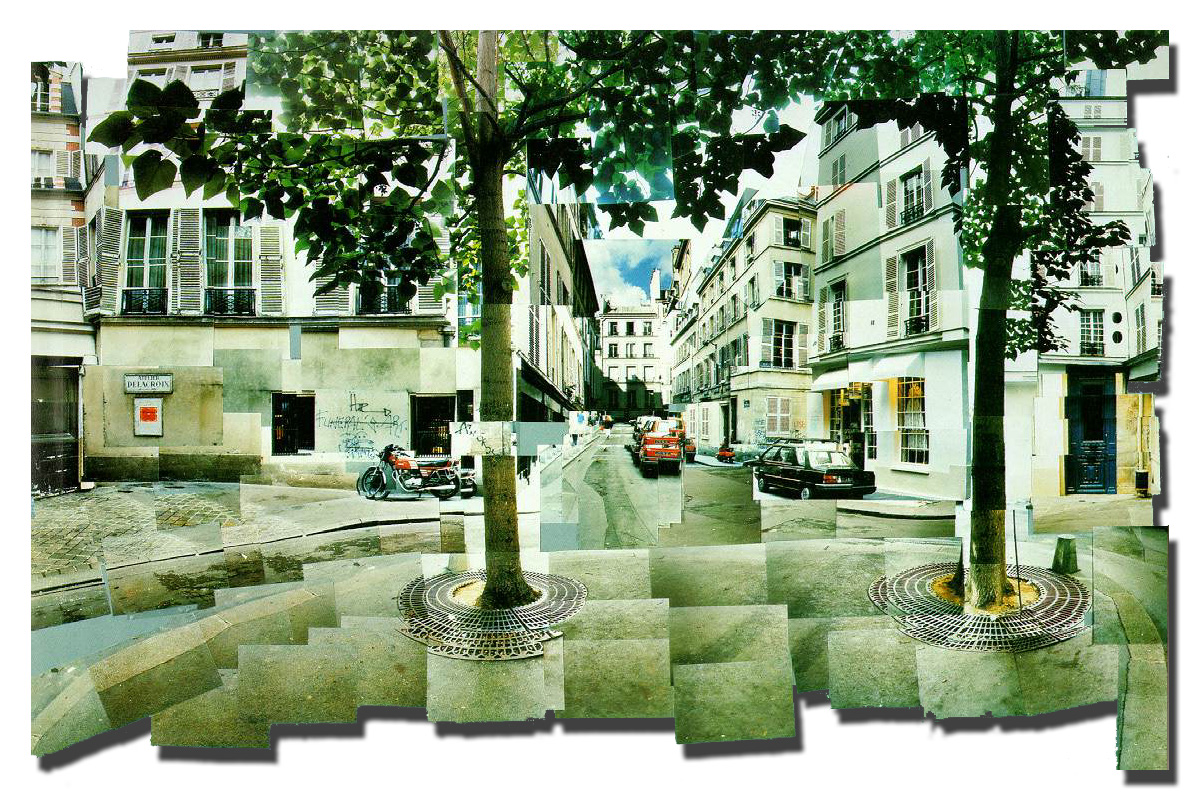
The scene is up to you, but I want to to experiment in a David Hockney-esk way. See photo 1. Hockney uses multiple photos to create a scene, but not of the photos have the same exposure, or the same range of focus. Also, if you look closely, you will see that he even changes his position slightly to create optical illusions- notice the tree, you can see through it.
David Hockney is painter from Great Britain who migrated to U.S.A. in the 1960's and found the land so grand (particularly the Grand Canyon) that it could not be photographed in one shot. Also he did not like the how the wide angle lens would distort the scene. So he decided to photograph a scene in a series and join it together. He called this collaging process "joiners".
Wednesday, November 17, 2010
9s Pin Hole Camera
Find 2+ examples of pin hole cameras for your Journal and 3-5 photos that were taken with a pin hole camera. Define what a pin hole camera is and how it works.
The Pin Hole Camera Assignment:You are to use a basic box that is completely light tight as a camera.
Try to take photos with your box by loading the photo paper in the darkroom and going outside to take your photos. Make sure you keep track of the time and hold steady with each exposure (a tripod can be handy).
You are to try the following exposures:
Here is a site to check out:
The Pin Hole Camera Assignment:
Try to take photos with your box by loading the photo paper in the darkroom and going outside to take your photos. Make sure you keep track of the time and hold steady with each exposure (a tripod can be handy).
You are to try the following exposures:
- Clear Subject- image is in focus, good exposure, subject is easy to identify.
- Double Exposure- Expose your photo paper 2 times. You image should still be clear and easy to see.
- Movement- Make sure you can identify your image. The movement should be very slow.
- Positive of one of the above. Use the enlarger to invert the darks to light and visa versa.
- Label all of your experiments and hand in.
Monday, November 15, 2010
Workpress Blogs
If you want to keep it private, but want to restrict viewers, then go to "Settings", on the left hand tool bar, then select "Privacy" and Select the third button "I would like my blog t be private, visible only to users I choose. Then select "Save Changes" and then type in my email address when it refreshes.
Monday, November 1, 2010
Photo9- BW Surveillance Project
Surveillance Contact Sheet & Prints
Contact Sheet- make sure you have the following:
Good quality negatives, well developed. 2
Negatives are organized in the same direction- not upside down or backwards 2
Good Exposure- not too dark or light 2
No Flaws, Chemical stains, scratches 2
Professional- Paper has been cut to the size of negatives- not wasteful. 2
Total 10
3 Prints- each print will be out of 5 marks:
Filter # none 3/90 5/150- Label each print with filter number
Good Exposure and contrast- not too dark or light. 1
Image is focused 1
Photo has an even border 1
Photo is cut to 3.5 x 5 1
There are no technical flaws. 1
Total 5 each
Contact Sheet- make sure you have the following:
Good quality negatives, well developed. 2
Negatives are organized in the same direction- not upside down or backwards 2
Good Exposure- not too dark or light 2
No Flaws, Chemical stains, scratches 2
Professional- Paper has been cut to the size of negatives- not wasteful. 2
Total 10
3 Prints- each print will be out of 5 marks:
Filter # none 3/90 5/150- Label each print with filter number
Good Exposure and contrast- not too dark or light. 1
Image is focused 1
Photo has an even border 1
Photo is cut to 3.5 x 5 1
There are no technical flaws. 1
Total 5 each
Subscribe to:
Posts (Atom)